Adaptable Access for a Deep Pump Station Excavation
A pump station construction project in Seal Beach, California, required dependable worker access into an excavation expected to reach approximately 44 feet below ground level.
The excavation was narrow in every direction, and its shoring piles and horizontal supports left limited room for conventional ladders, stairs, or a ground-supported access tower. The access system also needed to change as excavation continued without obstructing digging operations below.
SafeSmart developed a suspended modular stair tower configuration that could be extended as the excavation progressed. By combining Z-Stack modules with AdjustaStairs, the project team gained a consistent route from ground level to the changing excavation grade while preserving valuable working space beneath the tower.

The Challenge: Access That Had to Change With the Excavation
Providing access into a deep excavation is rarely a one-time installation. On this project, the working elevation continued to move downward as digging progressed.
A conventional scaffold stair tower would have required space at the bottom of the excavation and repeated changes as the work advanced. The contractor anticipated additional labor, scaffold rental costs, ongoing inspections, and repeated disassembly or relocation.
The restricted footprint made the problem more difficult. Shoring piles and internal horizontal supports occupied much of the available space, limiting where an access system could be placed. Any structure extending to the bottom could also interfere with excavation equipment and work taking place beneath it.

The project needed an access solution that could:
- Reach an eventual depth of approximately 44 feet
- Fit within a narrow, heavily shored excavation
- Adapt as the excavation became deeper
- Remain suspended above the active digging area
- Reduce repeated scaffold modification and relocation
- Provide stair access from grade to the current working elevation
- Be reusable after the pump station project was complete
The SafeSmart Solution
SafeSmart proposed a Z-Stack modular stair tower suspended from the excavation’s existing shoring support structure.
Z-Stack uses engineered, stackable modules to create a continuous stair route between elevations. For this application, the tower did not need to extend to or bear directly on the changing excavation floor. Suspending the system kept the area below it available for digging and other construction activity.
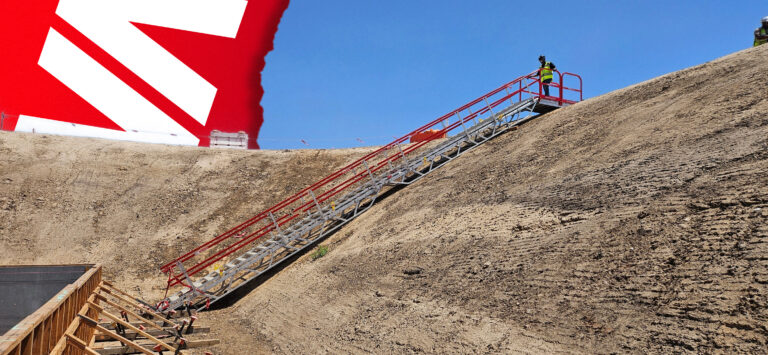
As excavation progressed, additional Z-Stack modules could be incorporated to extend the access route downward. AdjustaStairs connected the lower portion of the tower to the current excavated grade, accommodating the changing distance between the tower and the work area below.
During active digging phases, the AdjustaStairs could be removed to clear the space beneath the suspended tower. They could then be repositioned when access to the new grade was required.
How the Suspended Z-Stack Configuration Worked
The access strategy divided the descent into two adaptable components:
Z-Stack™ modular stair tower
Provided the primary vertical route through the excavation.
AdjustaStairs
Completed the transition from the lowest tower landing to the changing excavation floor.
The tower was supported from the excavation’s shoring system rather than relying on the bottom of the pit. This allowed the access route and excavation activities to progress together.
As the project moved deeper, the modular system could be extended without replacing the entire access arrangement. This helped the contractor maintain a familiar, dedicated path into and out of the work area throughout multiple excavation phases.
All supporting connections, configurations, installation procedures, and modifications were subject to the project-specific engineered design, manufacturer instructions, and site safety requirements.
Why This Approach Fit the Project
It preserved space in a narrow excavation
Suspending the stair tower reduced the need for a support footprint at the bottom of the pit. This was especially valuable where shoring elements and construction activity already competed for limited space.
It adapted to changing depth
Z-Stack™ modules could be added as the excavation progressed, allowing the access system to follow the work rather than requiring an entirely new arrangement at each stage.
It kept the active digging area clearer
The lower AdjustaStairs transition could be removed during excavation phases, leaving the area below the tower available for digging operations.
It reduced dependence on repeated scaffold rework
A conventional scaffold access system may have required recurring disassembly, relocation, rebuilding, and inspection as the excavation changed. The modular Z-Stack™ configuration gave the project team a more adaptable alternative.
It supported self-performed changes
The customer reported that its team could complete the planned additions without bringing a certified scaffolder back to the site for each extension. Any installation or reconfiguration must still follow the approved project design, SafeSmart instructions, and the contractor’s competent-person and site-safety procedures.
It could be used again
Unlike a project-specific temporary scaffold rental, the modular components could be retained and reconfigured for future excavations or other vertical-access applications.
Project Outcome
When SafeSmart representatives returned to the site several months later, the excavation was approaching its final phase.
The customer reported that the stair tower had been extremely helpful to the project team. They particularly valued the ability to extend the system themselves under the project’s approved process instead of relying on a scaffolding contractor for every planned addition.
The suspended configuration continued to provide access while allowing excavation work to proceed beneath it. What began as a difficult access problem became a reusable approach for managing vertical access in a changing, space-constrained work area.

Where This Approach Can Be Used
This suspended modular stair tower concept may be suitable for projects such as:
- ✓ Pump station excavations
- ✓ Wastewater and water infrastructure construction
- ✓ Wet wells and dry wells
- ✓ Deep utility excavations
- ✓ Shored shafts
- ✓ Cofferdams
- ✓ Below-grade concrete structures
- ✓ Tunnel and shaft access
- ✓ Excavations with internal bracing or walers
- ✓ Projects where access must extend as digging progresses
- ✓ Sites where a ground-supported stair tower would obstruct operations
Every suspended application requires project-specific assessment and engineering. The supporting structure, connection details, tower configuration, excavation sequence, loading, clearance, and applicable safety requirements must be evaluated before installation.
FAQs
Can a stair tower be suspended inside an excavation?
A modular stair tower may be configured as a suspended access system when the existing structure, connections, loads, and complete arrangement have been evaluated for the application. SafeSmart reviews the site conditions and access requirements to determine whether a suspended Z-Stack configuration is appropriate.
How can stair access follow an excavation as it becomes deeper?
Additional modular tower sections can be incorporated according to the approved configuration as the excavation progresses. An adjustable lower stair can bridge the remaining distance from the tower to the current working grade.
Does the stair tower have to rest on the excavation floor?
Not in every application. On this project, the tower was suspended from the shoring support structure, which kept it above the changing excavation floor. The feasibility of this approach depends on project-specific engineering and the available supporting structure.
Can the area below the stair tower remain open during digging?
For this project, the removable AdjustaStairs section allowed the contractor to clear the lower access transition during excavation activities. The exact removal and reinstallation process depends on the approved configuration and site procedures.
Can the contractor add Z-Stack modules without a scaffolding contractor?
Yes. The customer in this case, reported that its own team completed planned additions without requiring a certified scaffolder for each change. Personnel must still follow SafeSmart instructions, the approved engineered arrangement, applicable regulations, and the project’s competent-person and safety requirements.
How deep can a Z-Stack stair tower go?
SafeSmart has supplied Z-Stack Stair Towers over 300 feet tall – the reach is limitless! The appropriate height and number of modules depend on the application, tower configuration, support conditions, tie requirements, loading, and project-specific engineering. SafeSmart evaluates these factors before recommending a configuration.